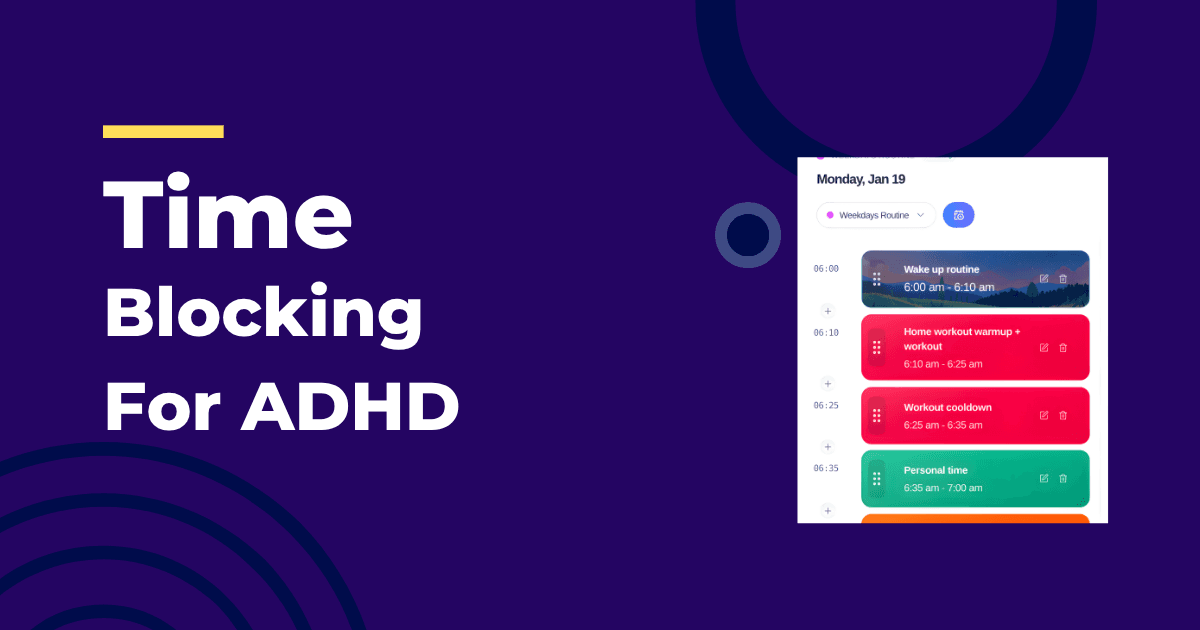
I built IntelliRoutine when I was 15 because I was tired of failing at time blocking. I'd block out my day perfectly on Sunday, then by Tuesday, the whole system collapsed. Sound familiar? If you have ADHD, you probably know that time blocking for ADHD feels like it should work — visual, structured, clear — but somewhere between theory and reality, it just... doesn't.
Research shows that 69% of adults with ADHD struggle with time perception, which makes traditional time blocking feel like trying to follow a map written in a language you don't speak. But before you abandon the idea entirely, here's the good news: time blocking for ADHD works brilliantly when you design it for how your brain actually functions — not against it.
Jump to:
- Why time blocking appeals to ADHD brains
- Why traditional time blocking still fails
- How to make it actually work
- Why AI makes it click
- How IntelliRoutine does it differently
- FAQ
Why Time Blocking Appeals to ADHD Brains
There's a reason why time blocking keeps coming up when people with ADHD search for solutions. It's not because it's magic — it's because it addresses something deeply real: the ADHD brain thrives with external structure.
When you have ADHD, internal time estimation is notoriously unreliable. Your sense of how long something takes, how much time has passed, or when you need to transition is genuinely broken. Time blocking works because it outsources that function to something visible and concrete — you can see your day blocked out, so your brain doesn't have to constantly estimate time.
The visual structure also appeals to the ADHD brain's love of urgency and clear boundaries. A blocked calendar isn't vague — it's real, it's there, and it creates a sense of obligation that pure willpower never will. That's why so many people with ADHD try time blocking over and over again, even after it's failed before.
Why Traditional Time Blocking Still Fails for ADHD
So if time blocking is so appealing, why does it collapse? Because traditional time blocking was designed for neurotypical brains — and those brains don't have the four critical issues that demolish the system for ADHD.
Time blindness and overruns. You block 30 minutes for email, but you're still there 90 minutes later. Your brain doesn't register time passing — you're genuinely shocked when someone tells you an hour is gone. Traditional time blocking assumes you'll notice when your block ends. You won't.
Task-switching paralysis. Even when you do notice the time, switching tasks is agonizing. Your brain is hyperfocused on what you're doing, and the idea of stopping feels impossible. Traditional time blocking treats task switches like they're free. For ADHD brains, they're expensive.
Over-scheduling and cascade collapse. When time blocking works for a few days, the temptation is to fill every moment. You get excited, add more blocks, optimize harder — and suddenly your schedule is so rigid that one missed task creates a domino effect. By Friday, everything is in ruins.
No recovery mechanism. ADHD brains tire faster from context switching, decision-making, and sustained focus. Traditional time blocking rarely accounts for this. You need buffer time built into the system — not just at the end of the day, but between every block.
This is the exact pattern I described in more depth in why planners don't work — the failure is always a design problem, not a you problem.
How to Make Time Blocking Actually Work for ADHD
If you want time blocking for ADHD to stick, abandon the 30-minute blocks and the rigid hourly grids. Here's what actually works:
Use wider time blocks. Instead of granular 30-minute segments, use 90-minute or 2-hour blocks. This gives your brain permission to hyperfocus, reduces task-switching friction, and acknowledges that time blindness means you can't hit precise transitions anyway.
Build in buffer time. Between blocks, add 15–30 minutes of unscheduled space. Not for procrastination — for decompression, transition friction, and the inevitable overrun. This isn't wasted time; it's the oil that makes the system function.
Use external notifications, not willpower. Calendar blocks alone aren't enough. You need something that will actively alert you when a block ends and make switching feel supported rather than jarring.
Allow dynamic rescheduling. This is where most systems fail for ADHD. They assume you'll stick to the plan. You won't — and that's not a character flaw, that's just how ADHD works. When you run over, the system should adapt, not collapse. AI tools are the only ones that do this automatically.
Traditional vs AI-Powered Time Blocking for ADHD
| Feature | Traditional Time Blocking | AI-Powered Time Blocking |
|---|---|---|
| Block duration | Fixed 30–60 min | Adaptive (90–180+ min) |
| When you overrun | Tasks marked late, plan breaks | Intelligently rescheduled |
| Buffer time | Manual — usually skipped | Automatic insertion |
| Task switching | Rigid, jarring | Supported with transitions |
| Recovery from missed days | Starts over from scratch | Picks up where you left off |
Why AI Makes Time Blocking for ADHD Finally Click
Here's what changed everything for me: I realized the problem wasn't time blocking itself — it was that I needed intelligent support underneath it. I needed something that understood my actual working patterns, not my idealized schedule. Something that didn't punish me for being ADHD.
AI changes this completely. Instead of you forcing your brain into a static schedule, AI learns your actual rhythms, predicts where you'll overrun, inserts buffer time proactively, and reschedules dynamically without judgment. Time blocking for ADHD stops being a rigid structure you're failing at and becomes a flexible guide that adapts to how you actually work.
If you want to see how this compares to other approaches, I put together a full breakdown of the best AI daily planners of 2026 — including what separates truly adaptive tools from ones that just look smart in demos.
How IntelliRoutine Does Time Blocking for ADHD Differently
When I built IntelliRoutine, I embedded every lesson from my own time blocking failures directly into the system. Here's what makes it different from everything else you've tried:
- Smart block sizing: Recommends block durations based on task type and your actual working capacity — not arbitrary 50-minute Pomodoros
- Automatic buffer insertion: Recovery time and transition space are built in from the start, not something you have to remember
- AI rescheduling: When you go over (and you will), IntelliRoutine quietly reshuffles your remaining day without breaking your momentum or creating a guilt spiral
- Pattern recognition: Over time it learns your actual rhythms — what you consistently overestimate, where you hyperfocus, when your energy drops — and adjusts accordingly
- Deadline protection: Flexibility without losing track of what actually matters
If you want a full picture of how IntelliRoutine compares to other AI planners for ADHD, I've covered that too.
Ready to stop fighting your brain and start working with it? Try IntelliRoutine free →
Frequently Asked Questions
Does time blocking work for ADHD?
Yes — but not the traditional way. Time blocking works for ADHD because it externalizes time management, something ADHD brains genuinely struggle with. It requires larger blocks, built-in buffer time, and dynamic flexibility. When those conditions are met — especially with AI-powered rescheduling — time blocking becomes one of the most effective ADHD strategies available.
How do you time block with ADHD?
Use 90-minute to 2-hour blocks instead of 30-minute chunks. Insert 15–30 minute buffers between blocks for overruns and decompression. Use hard notifications rather than relying on noticing time yourself. Most importantly, allow the schedule to flex — going over a block is normal for ADHD, not failure. AI tools that reschedule automatically make this dramatically easier.
What is the best schedule for someone with ADHD?
There's no universal answer, but effective ADHD schedules share key features: wider blocks for deep work, front-loaded high-priority tasks before energy drops, built-in breaks for movement and regulation, protected transition space, and realistic timelines that account for time blindness. Tracking your actual patterns over time is the fastest way to find what works for your specific brain.
Why can't people with ADHD stick to a schedule?
Because most schedules aren't built for ADHD. Time blindness means you don't sense time passing. Executive dysfunction makes task-switching genuinely hard. Hyperfocus pulls you in. These aren't willpower problems — they're neurological ones. A schedule that doesn't account for them will always fail. The fix is a system designed around recovery and flexibility, not rigid perfection.
About the Author
Profazia is the founder of IntelliRoutine, an AI-powered daily planner built around adaptive scheduling. He started building IntelliRoutine at 15 after failing at every time blocking system he tried — not from lack of effort, but because none of them were built for how his brain actually worked. His mission is simple: build the planner he always needed, and make it available to everyone who's given up on planning before.