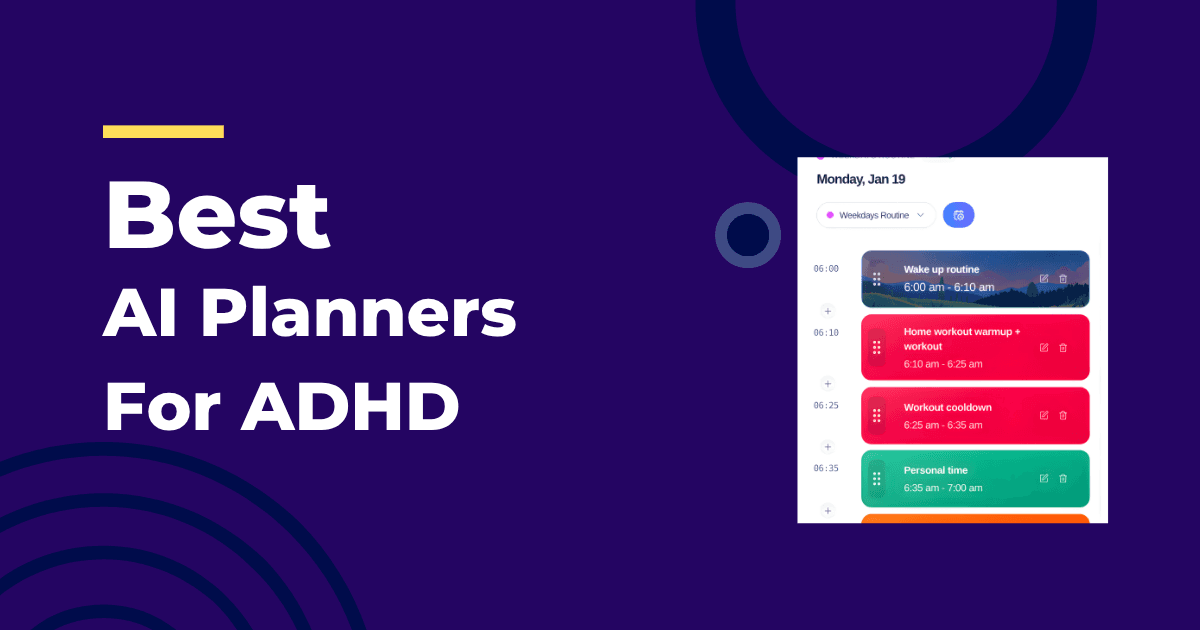
If you have ADHD, you already know the cruel irony: you need a planner more than anyone — and planners almost never work for you.
You start strong. You write everything down. You color-code it. You feel genuinely organised for about two days. Then one distraction, one hyperfocus spiral, one afternoon where time just disappeared — and the whole system collapses. You close the app, put down the notebook, and quietly add it to the graveyard of productivity tools that didn't stick.
The problem isn't you. The problem is that most planners were designed for neurotypical brains — brains that can hold a rigid schedule in their head, notice when they're off-track, and manually course-correct without much friction. For ADHD brains, each of those steps is a genuine executive function challenge. Studies estimate that up to 80% of people with ADHD struggle significantly with time management and planning — yet the tools designed to help almost never account for how the ADHD brain actually works. A tool that requires you to compensate for ADHD to use it isn't a tool for ADHD.
That's what I kept running into at 15 when I built IntelliRoutine. I needed something that handled the cognitive overhead for me — not something that added to it.
Jump to:
- What ADHD actually needs from a planner
- Why traditional planners fail ADHD brains
- Best AI planners for ADHD
- How to pick the right one
- FAQ
What ADHD Actually Needs From a Planner
Before comparing tools, it's worth understanding what makes a planner genuinely ADHD-friendly — because "ADHD-friendly" gets thrown around a lot without much meaning behind it.
Here's what actually matters:
Low Friction to Start
ADHD brains struggle with task initiation. If using your planner requires multiple steps before you can record a single thought, it won't get used consistently. The best AI planner for ADHD captures tasks and ideas instantly, with as little friction as possible — ideally in plain language, the way you'd say it out loud.
Automatic Recovery From Derailment
Time blindness is one of the most common and debilitating ADHD challenges. You don't just get distracted — you lose track of time entirely, and before you know it, the afternoon is gone and your schedule is wrecked. A planner that automatically reshuffles your remaining tasks when you fall behind is infinitely more useful than one that just shows you how far off-plan you are.
Externalized Structure
ADHD brains rely heavily on external structure to compensate for weaker internal regulation. The best AI planners act as that external structure — actively nudging you, surfacing what's next, and keeping the day moving without requiring you to hold the whole schedule in your head at once.
Forgiveness Built In
Perfectionism and ADHD are a brutal combination. Any planning system that punishes a missed day or a derailed afternoon will be abandoned. The right tool treats imperfection as the norm, not the exception — and helps you pick up right where you left off.
Why Traditional Planners Fail ADHD Brains
Standard planners — paper or digital — require a level of consistent self-monitoring that's genuinely hard for ADHD brains to sustain. You have to remember to check the planner, notice you're off-track, decide what to do next, and manually update everything. That's four executive function steps before you've done a single productive thing.
Add in the emotional dysregulation that comes with ADHD — the frustration of falling behind, the shame spiral of another abandoned system — and it's no wonder most tools don't stick. The planning system becomes its own source of stress, which is the opposite of what it should be.
If you've ever wondered why planners don't work for you specifically, the answer is almost certainly that they were never designed with your brain in mind.
AI planning changes this because it removes most of those manual steps. The system does the monitoring, the reshuffling, and the course-correcting — you just show up and do the next thing on the list.
Best AI Planners for ADHD in 2026
Here are the tools worth considering, evaluated specifically through an ADHD lens.
IntelliRoutine — Best AI Planner for ADHD Overall
IntelliRoutine was built around the exact problem ADHD creates for planning: the moment your day goes off-script, everything falls apart. IntelliRoutine's core feature is real-time adaptive scheduling — when something shifts, it automatically reshuffles your entire day without you having to do anything.
For ADHD specifically, this is transformative. You don't need to notice you're behind. You don't need to manually restructure your afternoon. The system handles all of that, so your cognitive load stays low and you can focus on actually doing things rather than managing your schedule.
What makes it particularly strong for ADHD:
- Natural language input: Add tasks by typing or talking the way you think — "remind me to call the doctor after lunch" — no forms, no friction
- Automatic rescheduling: Fall behind? Get distracted? IntelliRoutine quietly reshuffles the rest of your day so you always know what's next
- No streak punishment: Miss a day completely? It picks up exactly where you left off — no shame, no broken record, no reason to quit
- Structured but flexible: Gives you the external structure ADHD brains need, without locking you into a rigid plan that can't survive real life
- One clear next action: Always surfaces what to do right now — no decision fatigue, no scanning through a long list
If you've tried every planner and given up on all of them, IntelliRoutine is genuinely worth trying. Start free →
Reclaim.ai — Best for Calendar-Based ADHD Workflows
Reclaim is strong if your life revolves around a shared Google Calendar — common for people in team environments who need to protect focus time and habits around a meeting-heavy schedule.
ADHD strengths: Automatically finds and books focus time; defends habits against calendar creep
ADHD limitations: Requires fairly consistent calendar hygiene to work well; less helpful for daily routine structure outside of meetings
Motion — Best for Deadline-Driven ADHD
Motion automatically schedules your task list into your calendar based on deadlines and priorities. For ADHD brains who have lots of projects with real deadlines, the automatic prioritization removes a significant decision-making burden.
ADHD strengths: Removes task prioritization decisions; automatically reschedules when deadlines shift
ADHD limitations: Can feel overwhelming with lots of tasks visible at once; less focused on daily rhythm and energy management
Sunsama — Best for ADHD Wind-Down Rituals
Sunsama is a daily planning app built around intentional morning and evening rituals — pulling tasks from multiple sources and helping you decide what actually matters today.
ADHD strengths: Helps reduce overwhelm by limiting daily tasks; integrates with Notion, Asana, Linear
ADHD limitations: Requires consistent daily planning sessions to work; doesn't auto-reschedule when things go sideways
How to Choose the Right AI Planner for ADHD
The best AI planner for ADHD depends on where your biggest friction point is:
| Your biggest ADHD challenge | Best fit |
|---|---|
| Time blindness, derailment, recovery | IntelliRoutine |
| Protecting focus time around meetings | Reclaim.ai |
| Too many tasks, can't prioritize | Motion |
| Overwhelm, need to limit daily scope | Sunsama |
One piece of advice: don't evaluate a planner on a good day. Anyone can use any system when things are going well. Test it on a chaotic Tuesday when three things went wrong before noon. That's when you find out if it actually works for an ADHD brain.
The best AI daily planners of 2026 all handle good days fine. The ones worth using for ADHD handle the bad ones too.
Final Thoughts
The best AI planner for ADHD isn't the one with the most features. It's the one that does the most thinking for you — so you can spend your limited executive function on the things that actually matter, not on managing the tool itself.
Adaptive scheduling, automatic recovery, low-friction input, and zero punishment for imperfection. Those are the features that matter for ADHD brains. Everything else is noise.
IntelliRoutine was built with all of that in mind. If you've given up on planners before, it's worth one more try — with a tool that was actually designed for how real brains work. Try it free →
Frequently Asked Questions
What is the best AI planner for ADHD?
The best AI planner for ADHD automatically adapts when your day goes off-script and doesn't punish missed days. IntelliRoutine is the top pick — real-time rescheduling means ADHD brains never have to manually course-correct. Low friction, automatic recovery, and no streak pressure make it built for how ADHD actually works.
Can AI help with ADHD time management?
Yes. AI planners handle the executive function steps that are hardest for ADHD brains: monitoring the schedule, noticing when you're off-track, and deciding what's next. That external structure is exactly what ADHD brains rely on to stay functional — and it removes the cognitive overhead that makes traditional planning so exhausting.
Why do planners never work for people with ADHD?
Traditional planners require constant self-monitoring, manual updates, and perfect streaks — all genuine executive function challenges for ADHD. One bad day breaks the whole system. AI planners that auto-recover and auto-reschedule remove those barriers, making them far more sustainable for ADHD brains over the long term.
Is there a free ADHD planner app?
Yes. IntelliRoutine has a free tier with adaptive scheduling. Reclaim.ai and Motion offer free trials too. For ADHD, price matters less than recovery — test each tool on a chaotic day to see if it bounces back automatically. That's the real differentiator.
About the Author
Profazia is the founder of IntelliRoutine, an AI-powered daily planner built around adaptive scheduling. He started building IntelliRoutine at 15, driven by the same frustration that many ADHD users face — every planning system worked great until it didn't, and none of them helped you recover. His goal was to build the planner he always needed: one that keeps working even when your brain doesn't cooperate.