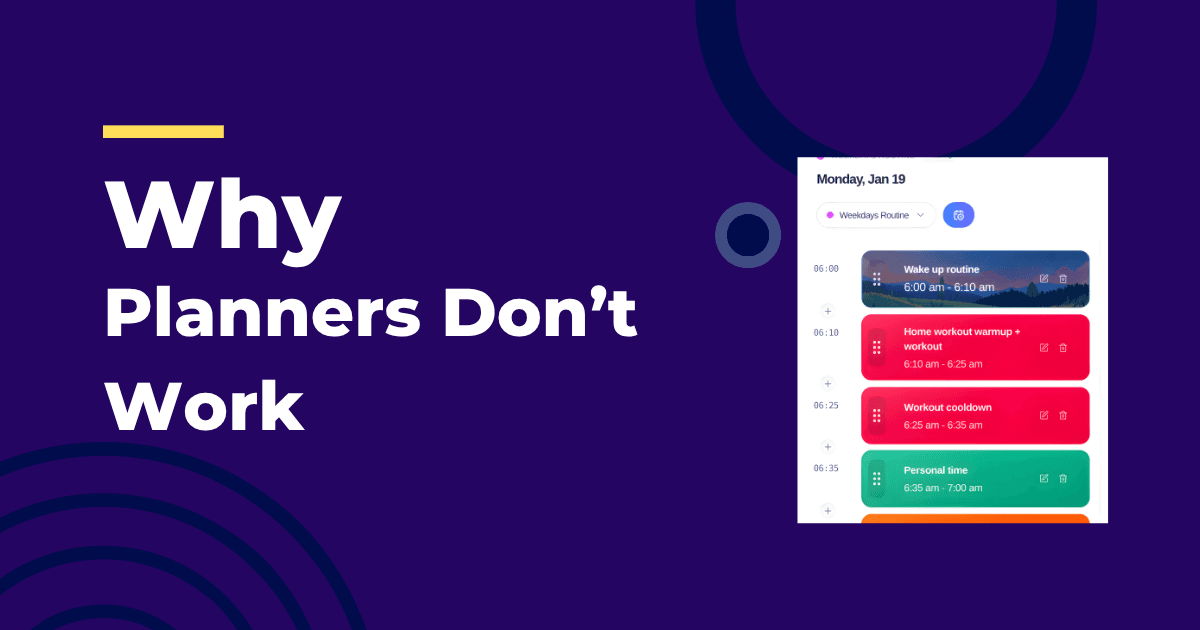
I've bought a lot of planners. And I know exactly why planners don't work — because I lived it.
The thick leather-bound ones with weekly spreads. The minimalist dot-grid notebooks everyone on YouTube swears by. The color-coded hourly planners that look incredibly satisfying until day three when they're just another thing sitting on your desk, staring at you with quiet judgment.
Sound familiar? You're not alone — and more importantly, it's not your fault. There's a reason the productivity market sells billions of dollars worth of planners every year while most people still feel like their days are completely out of control. Research suggests that over 80% of people abandon new planning systems within the first month — not because they lack discipline, but because the tools themselves are fundamentally broken by design.
I figured this out at 15, after my third failed attempt at "getting organized." Instead of buying another planner, I started building one that actually worked — and that eventually became IntelliRoutine. But before I get there, let me walk you through exactly why every planner you've ever tried was set up to fail you.
Jump to:
- 1. Too Rigid for Real Life
- 2. Can't Handle Interruptions
- 3. No Accountability Built In
- 4. Too Much Maintenance
- 5. One Missed Day Kills It
- The Fix: AI Planning
- FAQ
1. Traditional Planners Are Too Rigid for Real Life
Most planners are built around a fantasy version of your day — the one where every task takes exactly as long as you planned, nothing unexpected happens, and you glide from 7am journaling to 9am deep work like a productivity monk.
Real life doesn't work that way. Your morning meeting runs 40 minutes long. Your kid needs a ride. You get a message that derails your focus for an hour. And the moment one thing shifts, the entire day's plan is useless — because a paper planner can't move anything around for you.
Rigidity isn't a feature. It's a fatal flaw.
2. They Can't Handle Interruptions
This is the big one. The moment something unexpected happens — and something always happens — a traditional planner has nothing to offer you. It just sits there with your original, now-irrelevant plan written in permanent ink.
What do most people do? They abandon the plan entirely and wing the rest of the day. Or they spend 15 minutes manually crossing things out and rewriting a new schedule in the margins. Neither is a real solution. You're doing the work the planner was supposed to do for you.
A system that breaks the instant life intervenes isn't a system. It's a wishful thinking exercise.
3. There's Zero Accountability Built In
Paper planners are entirely passive. They don't remind you when you're spending too long on email. They don't notice when you've skipped your workout three days in a row. They don't push back when you schedule six hours of deep work on a Tuesday that already has four meetings.
They just... sit there. And when you don't follow through, they silently record your failure without offering any path forward. Real accountability requires something that actively engages with your behavior — not just a blank box waiting to be filled.
4. They Take Too Long to Maintain
Let me ask you something: how long does it actually take you to properly fill out your planner each week? Between the weekly review, daily planning pages, habit trackers, and goal-setting sections — for a lot of people it's 30–45 minutes. Every week. That's before you've done a single productive thing.
And then when your plan inevitably breaks down mid-week, you either rework it manually (more time) or stop updating it altogether (which kills the system). The maintenance burden is enormous relative to the actual value delivered. The tool is supposed to save you time, not consume it.
5. One Missed Day and the Whole Thing Falls Apart
This is the silent killer of every planner habit. You miss a day — maybe you were sick, maybe you were just exhausted — and suddenly there's a gap in your planner. That gap is psychologically devastating. The streak is broken. The record is imperfect. And rather than just picking back up, most people quietly stop using the planner altogether.
Planners punish imperfection. But life is imperfect. Any system that requires a flawless streak to stay useful isn't built for human beings.
So Why Planners Don't Work — And What Actually Does
All five of these failures point to the same root problem: traditional planners are static tools trying to manage a dynamic life. Understanding why planners don't work isn't just an intellectual exercise — it's the first step to finding a system that actually sticks.
The solution isn't a better paper planner. It isn't a prettier app with more color-coding options. The solution is a system that treats your schedule as something alive — something that adapts in real time when your day goes sideways, keeps you accountable without judgment, and requires almost no manual maintenance to stay useful.
That's exactly what AI planning does. And it's why I built IntelliRoutine. If you want to see how AI planners stack up, I've put together a full comparison of the best AI daily planners in 2026.
How IntelliRoutine Fixes What Traditional Planners Can't
When I was 15 and staring at yet another abandoned planner, the thing I wanted was simple: a system that kept working even when I didn't follow it perfectly. One that could survive a bad morning and still give me a useful afternoon.
IntelliRoutine is built around that idea. Here's what makes it different:
- Automatic rescheduling: When something in your day shifts, IntelliRoutine reshuffles everything downstream instantly. No manual rewriting. No wasted time.
- AI that understands your day: You can tell it "I need two hours to prep for Friday's presentation" and it finds the right slot, handles conflicts, and keeps everything balanced.
- Built for imperfect streaks: Miss a day? IntelliRoutine doesn't punish you for it. It picks up exactly where you left off and helps you move forward.
- Zero maintenance burden: Instead of filling out planning pages, you spend your time actually doing things. The system does the upkeep.
- Real accountability: It actively tracks your routine completion, nudges you when you're falling behind, and surfaces patterns so you can improve — not just record failure.
If you've ever found yourself thinking "I know what I need to do, I just can't make it stick," that's not a motivation problem. That's a systems problem. And IntelliRoutine is the fix. Try it free →
Frequently Asked Questions
Why do most people fail to stick with planners?
Most people fail to stick with planners because traditional planners can't adapt when life goes off-script. The moment one thing shifts, the plan becomes obsolete and there's no way to recover automatically. People abandon the system rather than rebuild it by hand. The failure is a design flaw, not a personal one.
Are digital planners better than paper planners?
Digital planners can be better, but most share the same flaw: they're static. The real upgrade isn't paper vs. digital — it's static vs. adaptive. AI-powered planners like IntelliRoutine automatically adjust your schedule in real time when life interrupts, which is what actually makes planning stick.
Why does my routine always fall apart after a few days?
Because most routines are built for a perfect day that never exists. There's no recovery mechanism — miss one block and the whole system breaks. A planning tool designed to bounce back automatically, rather than requiring a perfect streak to stay functional, is what changes this.
What is the best alternative to traditional planners?
The best alternative is an AI-powered planner that adapts in real time. Instead of a fixed schedule you maintain manually, you get a living routine that adjusts around your actual day. IntelliRoutine was built specifically to handle the interruptions and missed days that kill every traditional planning system.
About the Author
Profazia is the founder of IntelliRoutine, an AI-powered daily planner built around adaptive scheduling. He started building IntelliRoutine at 15 after experiencing firsthand why planners don't work — watching routine after routine collapse the moment life got in the way. His mission is simple: build the system he always wished existed — one that keeps working even when you don't follow it perfectly.