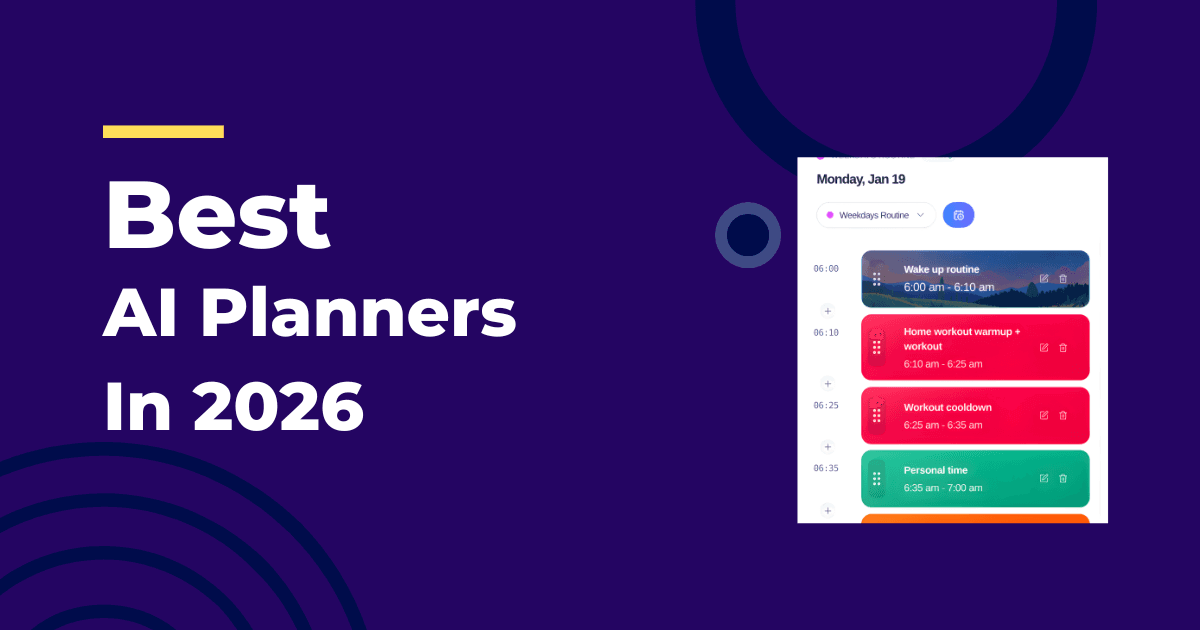
We've all been there: you build the perfect daily schedule, and then life happens. A meeting runs long, a task takes twice as long as expected, or you just wake up exhausted — and suddenly your entire plan is garbage. Most planners, AI-powered or not, leave you scrambling to rebuild from scratch. In fact, studies show that over 80% of people abandon static schedules within the first week because they can't handle real-life disruptions.
That's the problem the best AI daily planners of 2026 are finally solving — and why choosing the right one matters more than ever.
What Makes an AI Daily Planner Actually Good in 2026?
The AI planning space has exploded over the past two years. But not all tools are created equal. Here's what separates genuinely useful AI planners from the ones that just look impressive in demos:
1. Real-Time Adaptability
A static schedule generated by AI is only marginally better than a hand-written one. The game-changer is live adaptation — when your 9am meeting runs until 10:30, your planner should automatically shift everything downstream and re-optimize your day, without you lifting a finger.
This is the single biggest differentiator in 2026. Look for planners that treat your schedule as a living document, not a snapshot.
2. Context Awareness
The best AI planners understand you. They learn when you do your best deep work, how long your tasks actually take (not how long you think they'll take), and what kind of commitments you have that can't be moved.
Look for tools that:
- Track your actual completion times vs. estimates
- Respect recurring commitments and personal constraints
- Factor in energy levels throughout the day
3. Conflict Resolution Without Headaches
When two things clash on your calendar, a great AI planner doesn't just flag the conflict — it proposes solutions. It knows which task has a hard deadline, which meeting can be moved, and what the least disruptive path forward looks like.
4. Natural Language Input
In 2026, typing out a formal task entry feels archaic. The best tools let you say "I need to prep for Thursday's presentation, it'll take about 2 hours" and figure out where to slot it automatically.
5. Integration With Real Life
Your planner is only as useful as the data it works with. Deep calendar sync, task manager integration, and awareness of your time zones and working hours are now table stakes.
Top AI Daily Planners Worth Your Attention in 2026
Finding the best AI daily planner for 2026 means looking past the marketing. We tested these tools across real-world routines to see which ones actually hold up when your day falls apart.
IntelliRoutine — Best AI Daily Planner for Adaptive Routines
I built IntelliRoutine at 15 after watching my own routines collapse every week. The problem was never motivation — it was that no tool could handle the moment reality interrupted the plan.
IntelliRoutine is purpose-built around the idea that your routine should adapt to your life, not the other way around. When something goes off-script, IntelliRoutine automatically reshuffles your entire day — reprioritizing tasks, preserving your must-do blocks, and keeping you on track without any manual intervention.
What sets it apart:
- Instant reschedule: The moment you mark something as done (or skip it), the rest of your day adjusts automatically
- AI sync: Talk to the built-in assistant to add tasks, shift blocks, or completely restructure your afternoon in plain English
- Smart conflict resolution: When your calendar throws a wrench in your plans, IntelliRoutine surfaces the smartest fix — not just a list of problems
- Built for real routines: Morning routines, work blocks, workouts, deep focus sessions — it understands the rhythm of a human day, not just a list of tasks
IntelliRoutine is ideal for people who have structured days but need flexibility baked in. If you've ever spent 20 minutes manually rearranging your schedule after one meeting moved, this tool eliminates that entirely. Try IntelliRoutine free →
Reclaim.ai — Best for Calendar Optimization
Reclaim focuses heavily on protecting time for habits and tasks within an existing Google Calendar setup. It's great if your calendar is your source of truth and you want AI to fill the gaps intelligently.
Strengths: Deep Google Calendar integration, habit scheduling, meeting optimization
Limitations: Less effective for people who need full routine planning beyond calendar blocks
Motion — Best for Task-Heavy Workflows
Motion automatically schedules your to-do list into your calendar based on deadlines and priorities. It's particularly strong for project-driven work where you have lots of tasks with varying urgency.
Strengths: Automatic task scheduling, deadline awareness, project management features
Limitations: Can feel rigid; less focused on the holistic rhythm of your day
Structured — Best for Visual Thinkers
Structured is a beautifully designed timeline-based planner for iOS and Mac. It's not AI-heavy, but its visual clarity makes it a favourite for people who need to see their day laid out.
Strengths: Beautiful UI, timeline view, Apple ecosystem integration
Limitations: Limited AI features; manual scheduling required
The Shift That Defines 2026: From Planning to Adapting
The trend that cuts across every top tool right now is a move away from "plan your day" toward "maintain your day." The best AI planners in 2026 aren't trying to help you build the perfect schedule once — they're trying to keep your day on track continuously, minute by minute.
This matters because life is inherently unpredictable. The planner that wins isn't the one with the slickest interface or the most integrations — it's the one that keeps working for you even when things go sideways.
If you're evaluating tools right now, the key question to ask is simple: what happens when your day breaks? A great AI planner has an answer. A mediocre one just shows you a broken schedule and hopes you figure it out.
How to Choose the Right AI Planner for You
Here's a quick decision framework:
| Your situation | Best fit |
|---|---|
| You want routines that auto-adapt throughout the day | IntelliRoutine |
| Your life runs through Google Calendar | Reclaim.ai |
| You manage lots of tasks with deadlines | Motion |
| You prefer a simple visual timeline | Structured |
Start with a free trial. Most of these tools offer one, and the difference between "this is fine" and "this changed how I work" becomes obvious within a week of actual use.
Final Thoughts
The best AI daily planner in 2026 isn't the one with the most features — it's the one that disappears into the background and keeps your day running, even when life doesn't cooperate. Adaptive scheduling, natural language input, and smart conflict resolution are no longer nice-to-haves. They're the baseline.
If adaptive routines resonate with you, IntelliRoutine is worth a serious look. It was built specifically for the problem of keeping your day intact when reality intervenes — and in 2026, that's exactly the problem worth solving. Start your free trial →
Frequently Asked Questions
What is the best AI daily planner in 2026?
The best AI daily planner in 2026 depends on your workflow. For adaptive routines that automatically reschedule around your real day, IntelliRoutine is the top pick. For calendar-first workflows, Reclaim.ai is strong. For task-heavy project work, Motion leads. The key differentiator across all of them is real-time adaptability — static AI-generated schedules are no longer enough.
Is there a free AI daily planner?
Yes. IntelliRoutine, Reclaim.ai, and Motion all offer free trials. IntelliRoutine's free tier lets you experience adaptive scheduling before committing. Most tools reveal their real value within the first week of daily use, so a trial is the best way to evaluate fit.
Can an AI planner schedule my entire day automatically?
Yes — that's exactly what the best AI daily planners of 2026 do. Tools like IntelliRoutine and Motion take your tasks, deadlines, and calendar events and build a full day schedule for you. The more advanced ones (like IntelliRoutine) also re-schedule automatically when something changes mid-day, without any manual input from you.
What's the best AI planner for iPhone?
IntelliRoutine and Structured both work well on iPhone. IntelliRoutine is a progressive web app accessible on any device, while Structured is a native iOS app with a strong visual timeline. If you're deep in the Apple ecosystem and want something native and beautiful, Structured is worth a look — but for adaptive AI scheduling, IntelliRoutine is the stronger choice.
How is an AI daily planner different from a regular calendar app?
A regular calendar app stores events. An AI daily planner actively manages your time — scheduling tasks around your commitments, resolving conflicts, respecting your energy levels, and adapting in real time when your day changes. In 2026, the best AI planners feel less like a tool you use and more like a system that runs in the background, keeping your day on track automatically.
About the Author
Profazia is the founder of IntelliRoutine, an AI-powered daily planner built around adaptive scheduling. He started building IntelliRoutine at 15 after experiencing firsthand how quickly even well-planned routines fall apart when life gets unpredictable. His focus is on building tools that keep working for you even when your day doesn't go to plan.